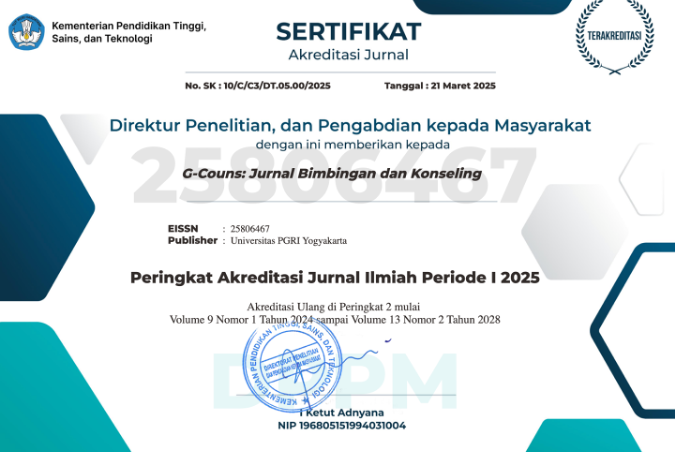
Older Sibling or Younger Sibling? The Dynamics of Self-Confidence and Emotional Stability Among University Students in Wetland Communities
DOI:
https://doi.org/10.31316/g-couns.v10i01.8381Abstrak
This study investigates the impact of birth order on self-confidence and emotional stability among university students residing in wetland communities. Using a quantitative survey design, 200 students, comprising 100 firstborns and 100 lastborns, from Lambung Mangkurat University were assessed using the Edwards Personal Preference Schedule (EPPS). Descriptive statistics, Mann-Whitney tests, and Structural Equation Modelling (SEM) were used to analyze the data. Results indicated that firstborn students exhibited significantly higher self-confidence (M = 3.57, SD = 1.26) and emotional stability (M = 3.43, SD = 1.26) than lastborns (p < .05). Family expectations and academic experiences emerged as key influences. SEM revealed that self-confidence strongly predicts emotional stability (β = 0.52, p < .001), with family background and educational experience having moderate effects. The findings underscore the psychological challenges faced by students in geographically isolated, resource-limited wetland environments. Tailored counseling interventions are recommended, particularly for lastborn students. Future research should investigate the intersection of cross-cultural and environmental factors.
Keywords: self-confidence, emotional stability, birth order, wetland communities, Edwards Personal Preference Schedule (EPPS)
Unduhan

Unduhan
Diterbitkan
Cara Mengutip
Terbitan
Bagian
Citation Check
Lisensi
Hak Cipta (c) 2025 Muhammad Andri Setiawan, Nina Permata Sari, Hendro Yulius Suryo Putro, Andry Ananda Putra Tanggu Mara

Artikel ini berlisensiCreative Commons Attribution-ShareAlike 4.0 International License.
The Authors submitting a manuscript do so on the understanding that if accepted for publication, copyright publishing of the article shall be assigned to G-Couns: Jurnal Bimbingan dan Konseling

G-Couns: Jurnal Bimbingan dan Konseling is licensed under a Creative Commons Attribution-ShareAlike 4.0 International License.